
TMJ Disorder Treatment in Mumbai
TMJ pain is one of the most common causes of chronic jaw discomfort, jaw clicking, headaches, and difficulty chewing seen in maxillofacial practice.
Most patients presenting with TMJ disorders do not describe their condition medically.
They usually report:
-
“My jaw clicks.”
-
“There’s pain near my ear.”
-
“I can’t open my mouth properly.”
-
“My jaw gets stuck while eating.”
-
“I wake up with headaches.”
-
“I’ve been taking painkillers for months.”
As oral and maxillofacial specialists, TMJ disorders are frequently encountered in forms that are:
- misdiagnosed,
- overtreated,
- ignored for years,
- or incorrectly attributed entirely to the bite.
Unfortunately, social media and aggressive commercial dentistry have created significant confusion around TMJ treatment.
Patients are often advised unnecessary:
- full mouth rehabilitation,
- irreversible bite changes,
- random aligner therapy,
- or prolonged splint use,
…without adequate diagnosis or evidence-based treatment planning.
What Is TMJ?
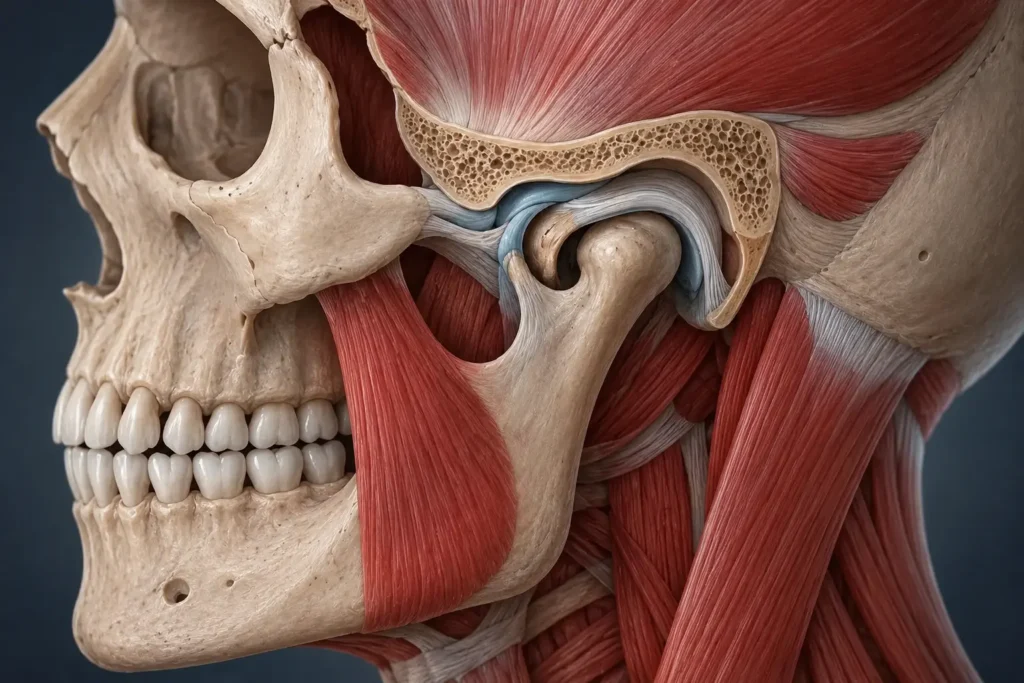
The TMJ (Temporomandibular Joint) is the joint connecting the lower jaw (mandible) to the skull, located just in front of the ear.
It is among the most complex joints in the body because it:
- rotates
- translates
- functions bilaterally,
- contains a fibrocartilaginous disc,
- and operates continuously during chewing, speaking, swallowing, yawning, and parafunctional habits like clenching.
The TMJ joint functions continuously during chewing, swallowing, speaking, and parafunctional habits such as clenching or grinding.
Dysfunction involving this system is termed: TMD (Temporomandibular Disorder)
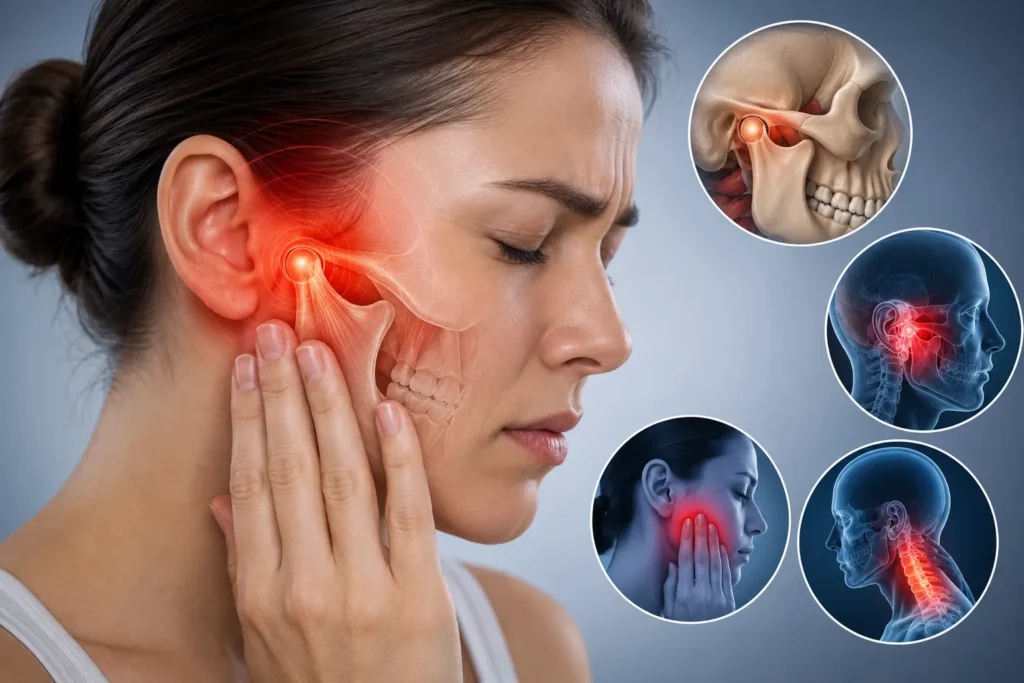
TMJ Symptoms: Early Signs of TMJ Disorder
TMJ disorders are not limited to jaw pain alone.
Patients commonly present with:
- jaw clicking or popping,
- pain near the ear,
- jaw locking,
- restricted mouth opening,
- morning jaw stiffness,
- temple headaches,
- facial muscle fatigue,
- neck pain,
- deviation while opening,
- difficulty eating hard foods,
- grinding or clenching habits,
- ear fullness,
TMJ disorders can cause jaw pain, headaches, clicking sounds, and difficulty chewing. At Maxora Superspeciality Clinic in Sion Mumbai, we commonly see patients from Chembur, Dadar, Matunga, and Wadala seeking treatment for persistent jaw joint problems.
One important clinical principle remains:
“A clicking jaw without pain is not always dangerous — but a locking jaw should never be ignored.”
Why TMJ Disorders Develop ?
TMJ disorders are multifactorial in nature.
In specialist clinical practice, the most common contributing factors include:
1. Bruxism & Muscle Overload
Stress-related clenching and grinding overload the joint and surrounding musculature.
2. Disc Displacement
The articular disc may shift out of position, resulting in clicking, intermittent locking, or restricted movement.
3. TMJ Arthritis
Degenerative and inflammatory joint changes may develop over time.
4. Trauma
Previous facial or mandibular injuries can destabilize joint mechanics.
5. Chronic Joint Overloading
Parafunctional habits such as excessive gum chewing, unilateral chewing, or nail biting contribute significantly.
6. Hypermobile Joints
Certain individuals naturally demonstrate ligament laxity and joint instability.
TMJ Treatment: Why Proper Diagnosis Matters ?
Patients searching for a TMJ specialist near Chembur or jaw pain treatment in Dadar often visit our Sion clinic for advanced TMJ care and orofacial pain management.
TMJ treatment depends entirely on the underlying cause.
Some patients primarily have:
-
muscular dysfunction,
-
stress-related clenching,
-
disc displacement,
-
inflammatory joint disease,
-
or TMJ arthritis.
Effective TMJ treatment requires accurate diagnosis rather than generic splints or irreversible bite changes.
Contemporary TMJ management is increasingly guided by:
-
randomized controlled trials (RCTs),
-
systematic reviews,
-
and meta-analyses.
This distinction is important because many popular online TMJ claims lack strong scientific support.
Conservative Treatment Works for Most TMJ Patients
The majority of TMJ disorders improve with conservative treatment, including:
-
soft diet,
-
habit correction,
-
physiotherapy,
-
anti-inflammatory therapy,
-
stress reduction,
-
and selective splint therapy.
A systematic review published in the Journal of Oral Rehabilitation demonstrated that conservative therapy provides meaningful symptomatic improvement in many TMD patients.
This closely reflects what is commonly observed in specialist TMJ practice.
Patients presenting with:
- muscular pain,
- early dysfunction,
- stress-related clenching,
- or inflammatory symptoms,
often improve substantially once joint loading and parafunctional habits are properly addressed.
This is why:
“Not every clicking jaw needs surgery.”
Mouth Guard for TMJ: Helpful or Overused?
A properly fabricated stabilization splint may help:
- reduce nocturnal grinding,
- decrease muscle hyperactivity,
- protect dentition,
- and reduce joint loading.
However, splints are not universal solutions.
Poorly fabricated appliances — particularly over-the-counter guards or aggressively adjusted splints — may worsen symptoms.
Evidence suggests stabilization splints can provide symptomatic relief in selected patients, particularly when combined with behavioral modification and conservative therapy.
This distinction is frequently overlooked online.
Physiotherapy for TMJ Disorders
Evidence supports physiotherapy for muscular and functional TMJ disorders.
Treatment protocols may include:
-
jaw stretching exercises,
-
trigger point therapy,
-
posture correction,
-
muscle relaxation,
-
and controlled mobility exercises.
In many patients, muscular dysfunction contributes more significantly to pain than structural joint disease itself.
TMJ Arthrocentesis
Minimally Invasive Treatment Supported by Level 1 Evidence
For patients with:
-
painful closed lock,
-
inflammatory internal derangement,
-
restricted mouth opening,
-
or persistent symptoms despite conservative therapy,
TMJ arthrocentesis can be highly effective.
The procedure involves lavage of the superior joint space to:
-
remove inflammatory mediators,
-
reduce intra-articular pressure,
-
improve disc mobility,
-
and restore joint movement.
A 2023 systematic review and meta-analysis of randomized controlled trials demonstrated that arthrocentesis was superior to conservative treatment in improving pain and mouth opening in selected TMJ disorders.
Another systematic review evaluating randomized clinical trials concluded that arthrocentesis is an effective minimally invasive procedure producing meaningful clinical improvement in appropriately selected patients.
Evidence-based reviews have further shown that arthrocentesis remains one of the most predictable minimally invasive interventions for internal derangement and inflammatory TMJ conditions.
In specialist clinical settings, carefully selected patients frequently demonstrate:
- improved mouth opening,
- reduced painful loading,
- and better functional recovery following the procedure.
When Is MRI Necessary for TMJ?
MRI becomes important when evaluating:
-
disc displacement,
-
internal derangement,
-
persistent locking,
-
joint effusion,
-
inflammatory pathology,
-
or symptoms not improving with routine treatment.
MRI remains the gold standard for evaluating soft tissue pathology involving the TMJ disc and joint spaces.
Many patients undergo repeated dental procedures without adequate TMJ imaging.
Conventional X-rays often fail to detect soft tissue pathology.
TMJ Arthritis: Frequently Underdiagnosed
TMJ arthritis is not simply “jaw pain.”
It may involve:
-
cartilage degeneration,
-
synovitis,
-
osteoarthritis,
-
autoimmune inflammation,
-
or condylar remodeling.
Patients frequently report:
-
grating sounds,
-
stiffness,
-
progressive pain,
-
chewing difficulty,
-
and worsening mouth opening.
Advanced imaging may demonstrate:
-
condylar flattening,
-
erosions,
-
osteophytes,
-
or degenerative remodeling.
Early diagnosis is important because chronic degeneration becomes progressively more difficult to manage.
A Common Clinical Pattern Seen in TMJ Patients
A frequently observed patient progression involves:
-
increasing stress,
-
nighttime clenching,
-
muscular tightening,
-
development of clicking,
-
delayed treatment seeking,
-
progressive inflammation,
-
and eventual reduction in mouth opening.
By the time specialist evaluation is sought, imaging may reveal:
-
disc displacement,
-
synovitis,
-
joint effusion,
-
or degenerative joint disease.
Evidence consistently demonstrates better outcomes when intervention begins before chronic structural degeneration develops.
Does Every TMJ Disorder Require Surgery?
No.
True TMJ surgery remains relatively uncommon.
Most patients improve with:
- conservative therapy,
- splints,
- physiotherapy,
- medications,
- or minimally invasive procedures such as arthrocentesis.
Surgical intervention is generally reserved for:
- ankylosis,
- severe degeneration,
- tumors,
- advanced structural pathology,
- or failure of conservative management.
“Most TMJ patients improve without major surgery when diagnosed early.”
How TMJ Disorders Are Properly Diagnosed ?
At Maxora Superspeciality Clinic, TMJ evaluation typically includes:
- detailed clinical history,
- muscle examination,
- joint palpation,
- mouth opening assessment,
- occlusal evaluation,
- joint sound analysis,
- imaging when indicated,
- and differential diagnosis.
This is critical because not all jaw pain originates from the TMJ.
For expert evaluation and advanced treatment in Mumbai, visit Maxora Superspeciality Clinic – Advanced Dental and Oral Cancer Care.
Conclusion
TMJ pain, jaw clicking, locking, headaches, and difficulty chewing are common signs of temporomandibular joint disorders that should not be ignored. Early diagnosis and evidence-based TMJ treatment can help prevent chronic pain, joint damage, and worsening jaw dysfunction.
For expert TMJ treatment in Mumbai, visit Maxora Superspeciality Clinic and consult Dr. Shivangi Agarwal for advanced diagnosis, personalized care, splint therapy, and minimally invasive TMJ management.
REFERENCE
- Al-Moraissi EA et al. Conservative management of temporomandibular disorders. Journal of Oral Rehabilitation. PubMed Reference
- Thorpe A et al. Systematic review and meta-analysis of randomized controlled trials comparing arthrocentesis with conservative treatment for TMJ disorders. 2023. PubMed Reference
- Guarda-Nardini L et al. Arthrocentesis of the Temporomandibular Joint: Systematic Review of Randomized Clinical Trials. Journal Reference
- Dolwick MF. Temporomandibular joint arthrocentesis: an evidence-based review. Full Text Review
FAQ
1. What are the common symptoms of TMJ disorder?
Common symptoms of TMJ disorder include jaw pain, clicking or popping sounds while chewing, difficulty opening the mouth, headaches, facial pain, ear pain, and jaw stiffness. Some patients may also experience jaw locking or discomfort while speaking and eating.
2. Why does my jaw click when I eat or open my mouth?
Jaw clicking or popping is often associated with temporomandibular joint (TMJ) dysfunction. It can occur due to bite imbalance, stress-related teeth grinding, joint inflammation, or disc displacement within the jaw joint. Persistent clicking along with pain should be evaluated by a TMJ specialist.
3. Can TMJ disorder cause headaches and ear pain?
Yes. TMJ disorders commonly cause headaches, facial muscle tension, neck pain, and pain near the ears because the jaw joint and surrounding muscles are closely connected to facial nerves and muscles. Many patients mistake TMJ pain for dental pain or ear problems.
4. When should I see a TMJ specialist in Mumbai?
You should consult a TMJ specialist if you experience persistent jaw pain, difficulty chewing, jaw locking, limited mouth opening, headaches related to jaw movement, or clicking sounds that worsen over time. Early diagnosis can help prevent chronic jaw joint problems.
5. Where can I get TMJ treatment near Sion, Chembur, or Dadar?
Patients from Sion, Chembur, Dadar, Matunga, Wadala, and nearby areas of Mumbai visit Maxora Superspeciality Clinic for evaluation and treatment of TMJ disorders, jaw pain, facial pain, bite problems, and jaw joint dysfunction.